Overview
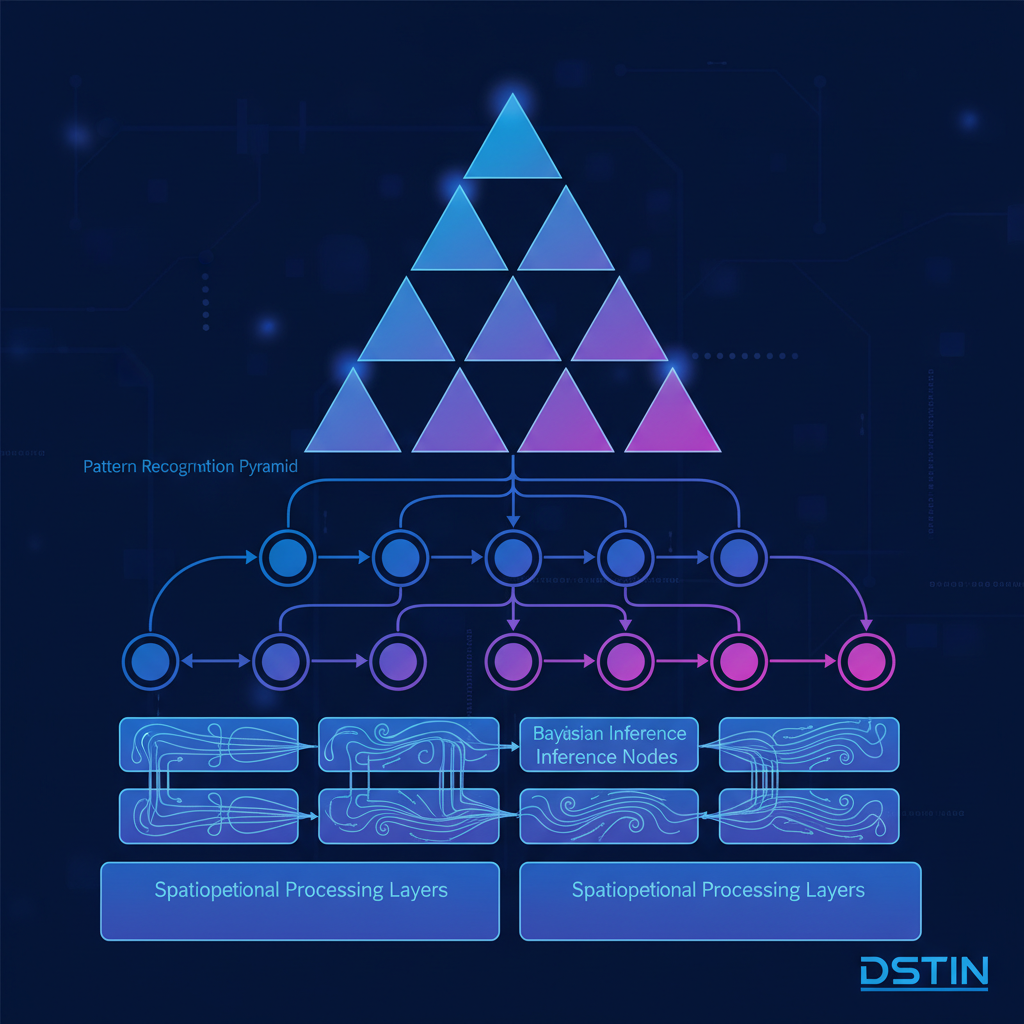
This paper, published in the AAAI Fall Symposium on Biologically Inspired Cognitive Architectures II (2009), introduces DeSTIN (Deep SpatioTemporal Inference Network) - a novel deep learning architecture designed to address the challenges of processing high-dimensional signals for robust pattern recognition.
Authors: Itamar Arel, Derek Rose, and Robert Coop Institution: Machine Intelligence Lab, Department of Electrical Engineering and Computer Science, The University of Tennessee
Key Contributions
The DeSTIN architecture represents a significant advancement in deep learning by combining several innovative approaches:
- Hierarchical Structure: Inspired by neuroscience research suggesting the neocortex comprises identical building blocks (cortical circuits) in a hierarchical arrangement
- Unsupervised Learning: Utilizes online clustering algorithms to learn pattern representations without requiring labeled data
- Bayesian Inference: Employs probabilistic belief updates to capture both spatial and temporal dependencies in observations
- Scalability: Designed for parallel and pipelined implementations, making it suitable for GPU acceleration
Technical Innovation
Unlike Deep Belief Networks (DBNs) that require greedy layer-wise pre-training, DeSTIN offers several advantages:
- No Pre-training Required: All layers train concurrently from initialization
- Spatiotemporal Modeling: Inherently captures both spatial and temporal dependencies in data
- Multi-modal Capability: Can operate on various input modalities given appropriate distance metrics
- Robustness: Demonstrates invariance to noise, scale, rotation, and lighting conditions
Experimental Results
The paper demonstrates DeSTIN’s capabilities through pattern recognition experiments on 32x32 pixel binary images, achieving near-perfect classification accuracy even with additive white Gaussian noise (SNR 10dB). The four-layer architecture successfully learned to distinguish between letters A, B, and C presented in motion sequences.
Significance
This work laid important groundwork for biologically-inspired deep learning architectures and contributed to the growing understanding of how hierarchical probabilistic models can effectively process high-dimensional sensory information - a capability that remains central to modern artificial intelligence systems.