About This Publication
This academic paper, co-authored with Bernard P. Zeigler, Chungman Seo, and Doohwan Kim at RTSync Corp., presents an advanced methodology for developing interconnected families of simulation models using the System Entity Structure (SES) framework within the MS4 Modeling Environment.
Key Contributions
The paper introduces an expanded concept of suites of models, where multiple related families of models can be composed, merged, and managed as coherent units. This extends beyond traditional single-family model development to support complex systems-of-systems modeling scenarios.
The Suite of Models Concept
The research distinguishes between three types of model organizations:
- Single Family of Models: A single SES implementing one family of models
- Multiple Unrelated Families: A set of non-overlapping SESs representing unrelated model families
- Suite of Related Families: A set of intersecting SESs representing related model families that share components
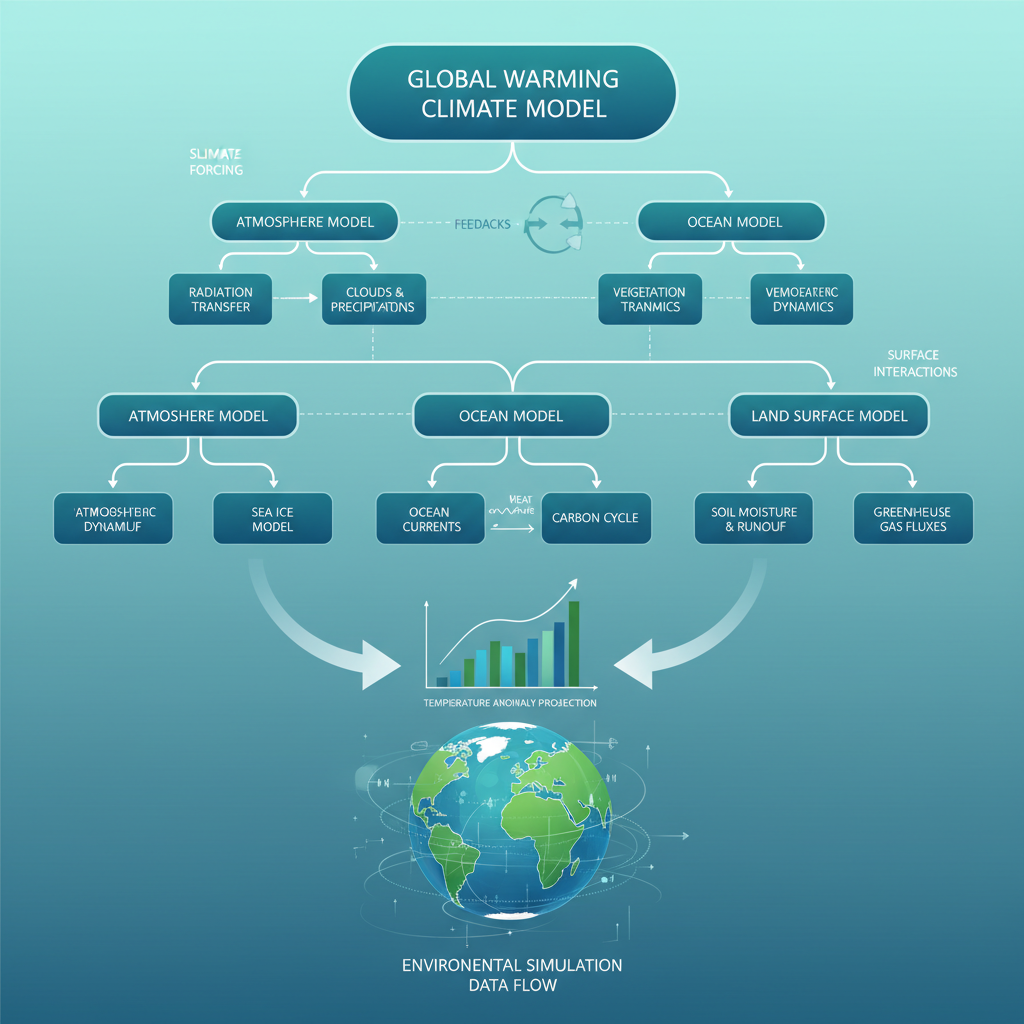
Global Warming as a Case Study
The paper uses global warming as a domain example, demonstrating how different climate phenomena can be modeled as interconnected families:
- Greenhouse Effect Model Family: Examines the warming mechanism caused by atmospheric carbon accumulation
- Polar Ice Melting Model Family: Models how global warming causes increased Arctic ice melting
- Permafrost Melting Model Family: Explores the feedback cycle where permafrost melting releases additional CO2
- Sea Level Rising Model Family: Simulates ocean level changes due to ice cap melting
- Storm Intensity Model Family: Models increased precipitation severity from atmospheric warming
- Flood Increasing Model Family: Combines sea level and storm factors affecting flood incidence
- Drought Increasing Model Family: Models reduced surface water from atmospheric moisture changes
Technical Innovation
The paper details how the merging operation for SES composition mirrors the DEVS model composition process, enabling:
- Hierarchical composition of model families
- Bottom-up testing via pruning and transformation
- Reuse of validated components across multiple model families
- Declarative specification using constrained natural language
Significance
This work advances the field of modeling and simulation by providing a systematic approach to developing complex, interrelated model families. The marketplace of models concept, backed by cloud-based repositories, enables collaborative development and reuse of simulation components across research teams and organizations.
The methodology is particularly valuable for domains like climate science where multiple interacting phenomena must be modeled together while maintaining the ability to study each phenomenon independently.